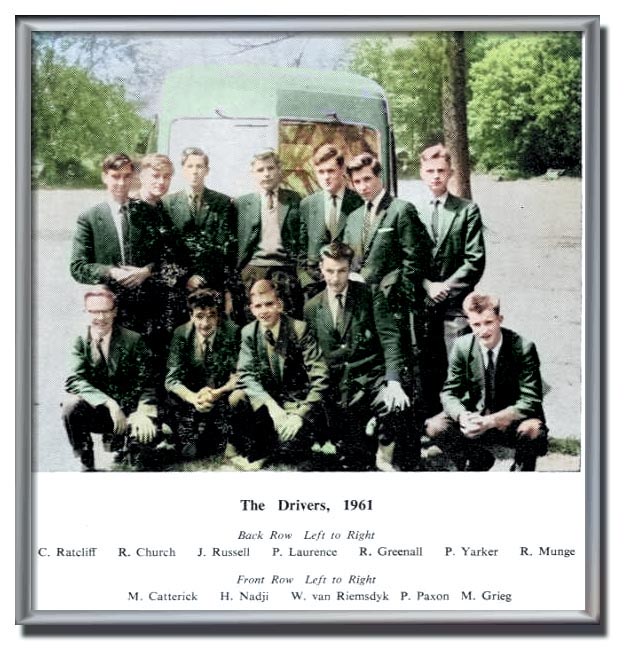
|
DRIVING
REVIEW
Although
it is probably not a unique feature of a school magazine to include an
article on driving, it will no doubt strike a 'foreigner' to the school
as somewhat peculiar, especially the aspect in which the subject must be
approached. In a world of automation, it is inevitable that any business
concern would compete profitably without it.
This school, at its present standard, would not exist without it.
Driving and the Motor Vehicle play a vital part in the running of the
school and that is why it has its deserved place in this magazine.
The most dominating and characteristic vehicle
of the school's transport is the double-decker.
Although spoken of in the singular, there are in fact two
double-deckers. Both are
ex-London Transport omnibuses, but only one is in current use. The older
of the two stands as witness td its duties at the rear of the school,
whilst the newer one, now decorated, for the most part, in school
colours, performs the regular duties. These twp double-deckers have
relieved pressure on the school time schedule, and although I am not an
authority on the matter, has cured several financial problems. Before
the time of the double-deckers the Commer, and before that a very large
shooting-brake, helped cover the many thousands of miles to and from
school, assisted by a private coach firm.
During the school's existence there have been numerous changes in
vehicles owned by the school. The Headmaster I believe once had a
motor-cycle! At present his
wife owns a Wolseley, whilst he has a Morris Mini-minor. I have heard
various comments by the Headmaster in favour of this economical and most
manageable little car.
For the sake of the 'outsider' to the school's curriculum, I must
explain that it is common practice for boys, attaining the age of
seventeen to learn to drive at the school. It is not a compulsory
measure, but most modern boys have some desire to learn. Most skill is
gained through driving the Hillman shooting-brake to and' from school,
but more advanced learners have the pleasure of driving the Morris
Mini-minor in King's Lynn at week-ends for the sake of refinement.
There are, at the time of writing, twelve fully-qualified
drivers. At the start of this school year there were four, Michael Greig,
Robert Church, Peter Yarker and Cohn Ratcliff. Since then the following
have passed their tests: Hassan Nadji (Nov. '60), John Cullin (Nov.
'60), Jonathan Russell (Nov. '60), Peter Paxon (Jan. '61), Richard
Greenall (Jan. '61), P. Laurence (Jan. '61), William van Riemsdyk (Feb.
'61) and Michael Catterick (Feb.'61). We hope the total to be about
fifteen by the end of term. This compares vividly with the year
1958-1959 when two boys "filled the bill" for all school
drivers.
Readers may be interested that a driving chart had to be designed
to keep check of all mileages, mainly for the sake of fairness.
There is considerable controversy about boys driving. Because of
this, together with continual warning and a sense of responsibility
amongst the drivers, the driving average is high. (However, one must
admit that not on all occasions do gateposts, etc., remain still whilst
the vehicle passes by!).
It is worth noting here that there used to be a motor club within
the school. Due to the expense of trying to continue the production of a
motor magazine without seeking assistance, the club disintegrated.
However, I have found boys with considerable interest in motoring
and the combustion engine who would be keen to join such a club were it
revived. I have several ideas on the way in which a club could be run.
Unfortunately, it would have to be left for someone else next year. With
the expanding school possibly to the scientific side, next year, a
chance for boys to know more about the combustion engine and other
technical details would be ideal.
It is on that somewhat ambitious note that I end. C.T. Ratcliff |
 |